
What makes something precious? ‘Precious,’ is used to describe the value of something. Noting something as precious highlights the effect it has on someone, a connection, or an emotional response. However, many raw materials are only considered precious because of their monetary value—what is it worth?
Alternatively, many things are considered precious because of the ideas that they were built from. The artwork selected for this KMA picks considers the way different artists in the KMA’s permanent collection have used precious materials or material byproducts to make their artwork.
When looking through the collection, focus was given to gold, silver, and platinum (palladium) because financial investors identify them as highly traded and valuable materials. Copper was also included in this search due to its long-term use by humans. Items from within these groups were chosen based on the creative ways the artist incorporated the precious materials into their artwork.
Gold
Though the days of the ‘Gold Standard,’ are long gone, many people still equate gold with material wealth. Gold is still considered to be a stable, smart investment. The artwork in this selection each use gold in a different way: gold leaf on a flat or 2D surface, gold embedded in a tooth, and applied like paint as gold luster.
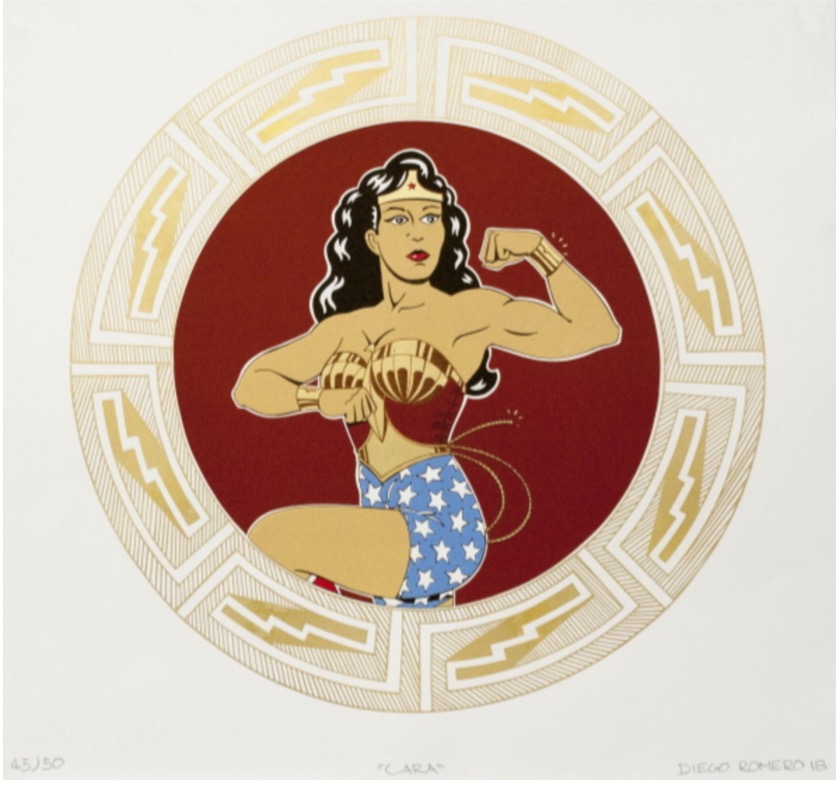
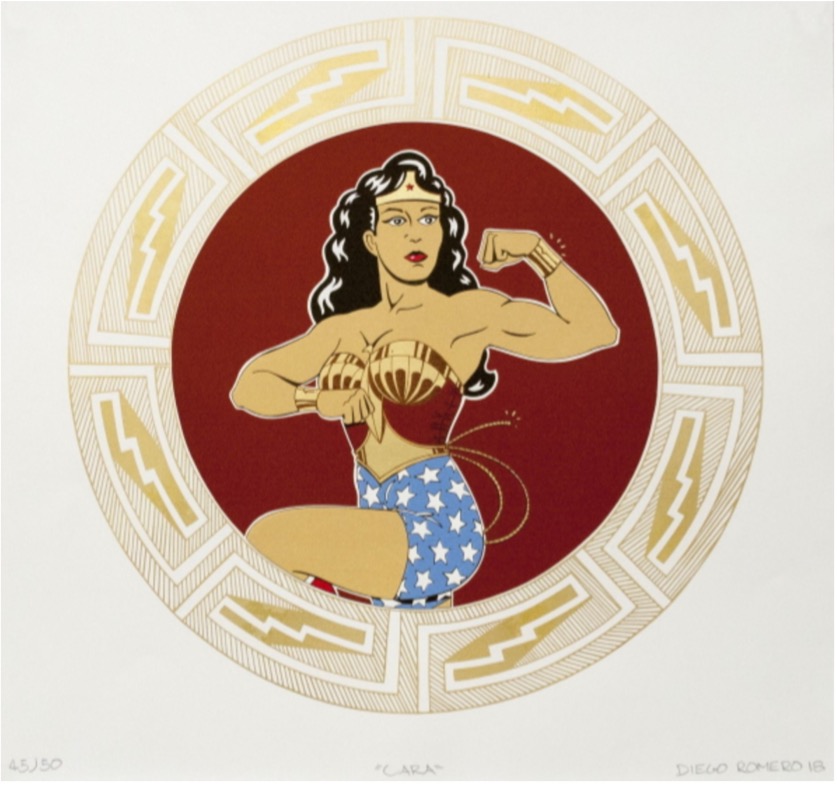
Diego Romero (b. 1964)
Cara
2018
Lithograph; Ink, Gold Leaf, Paper
KMA 2018.03.10
Diego Romero is a Cochiti Pueblo ceramicist and printmaker from Santa Fe, New Mexico. Many of his pieces are developed by combining traditional materials and techniques alongside pop culture references.
Cara is a lithographic print of the artist’s wife, contemporary fine art photographer Cara Romero, as pop culture icon—Wonder Woman. Gold leaf is not only a precious material, but it is also an ancient technique requiring finesse, precision, and patience to apply. Using gold, Romero draws attention to his Pueblo history while redirecting the pop culture iconography of Wonder Woman to include his wife, a member of the Chemehuevi Indian Tribe.
Both Diego Romero and Cara Romero are working artists. Use the links to learn more.
Lloyd E. Moore (1931-2010)
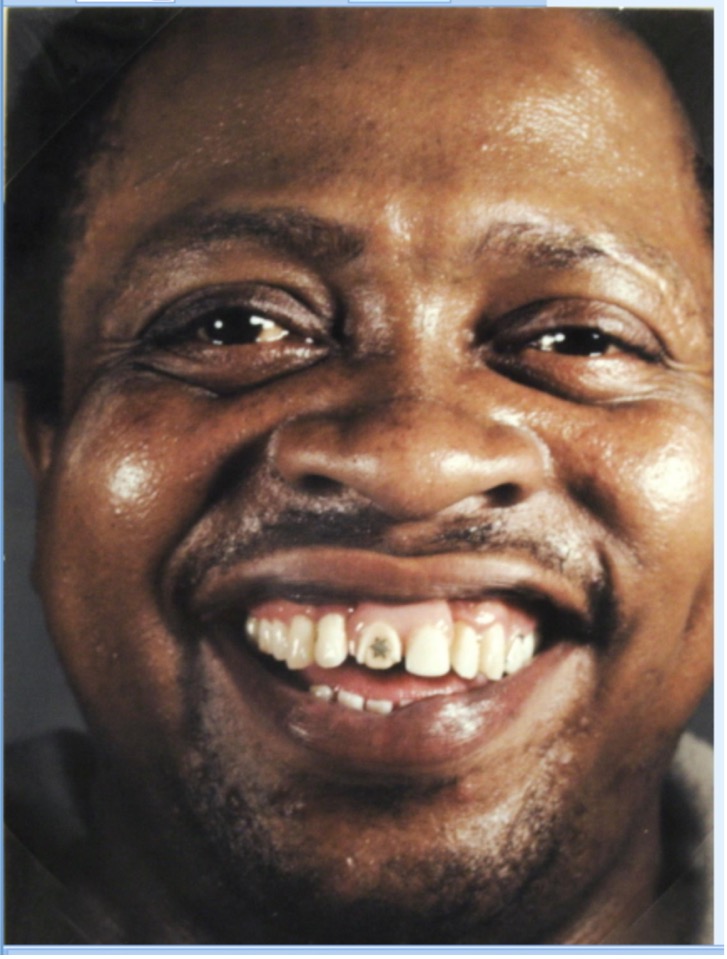
Wilbur “Butch” Hard
c. 1980
Photograph; Polaroid Print
KMA 2008.04.38
Lloyd E. Moore was a long-time, SE Ohio photographer and lawyer. A United States Marine during the Korean War, Moore was a prolific photographer.
Taken using a Polaroid camera, this photograph of Wilbur “Butch” Hard, seems to capture a precious moment in time. Smiling widely, we glimpse a gold star in Butch’s front tooth. The instant quality of the polaroid is different than other types of film because the captured moment becomes a physical object instantly. More than the glimpse of gold, Moore captured a piece of humanity.
Click here to learn more about the Lloyd E. Moore Photograph Collection through the University Libraries.
Claire Curneen (b. 1969)
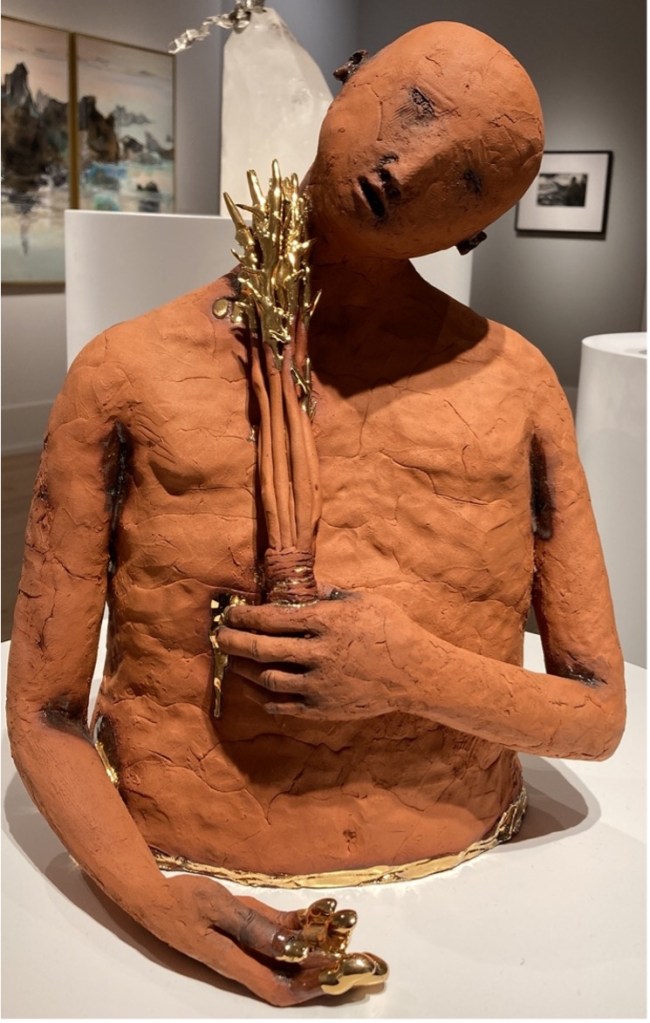
Man of Sorrows
2012
Ceramic Sculpture;
Terracotta and Gold Luster
KMA 2012.05.03
Irish artist Claire Curneen creates sculptures using porcelain, terracotta, and black stoneware. Curneen accents detailed passages of her sculptures by applying a variety of materials onto the surface of the clay, like gold luster.
Man of Sorrows, a terracotta sculpture of an unknown figure, is splashed with gold luster on its fingers, joints, and base. Like much of Curneen’s work, there is an engaging use of material. The matte quality of the figure absorbs light, becoming a place for the eye to rest and contemplate. Meanwhile, the gold luster is activated by the light and glows warmly under gallery lights. Man of Sorrows was recently on display at the KMA in CONVERSATIONS…, an exhibition curated by the KMA education team.
Click here to learn more about Claire Curneen’s practice and artwork
Silver
Gold and silver go together like peanut butter and jelly; they’ve seemingly become a set. Like gold, silver is considered a precious metal. However, it is also used in everything from keyboards to medicine. Like each of the materials featured in the search, silver continues the theme of variation. This section is split into two groups: gelatin silver photographs and items made using silver.
Gelatin silver photographs are created by applying a chemical solution created from silver salts and gelatin. The silver salts, suspended in the gelatin solution, can be applied to a surface. Photographers expose the surfaces to light, capturing an image which can then be developed. Each of the photographs in this selection were produced using the gelatin silver process during the 20th century.
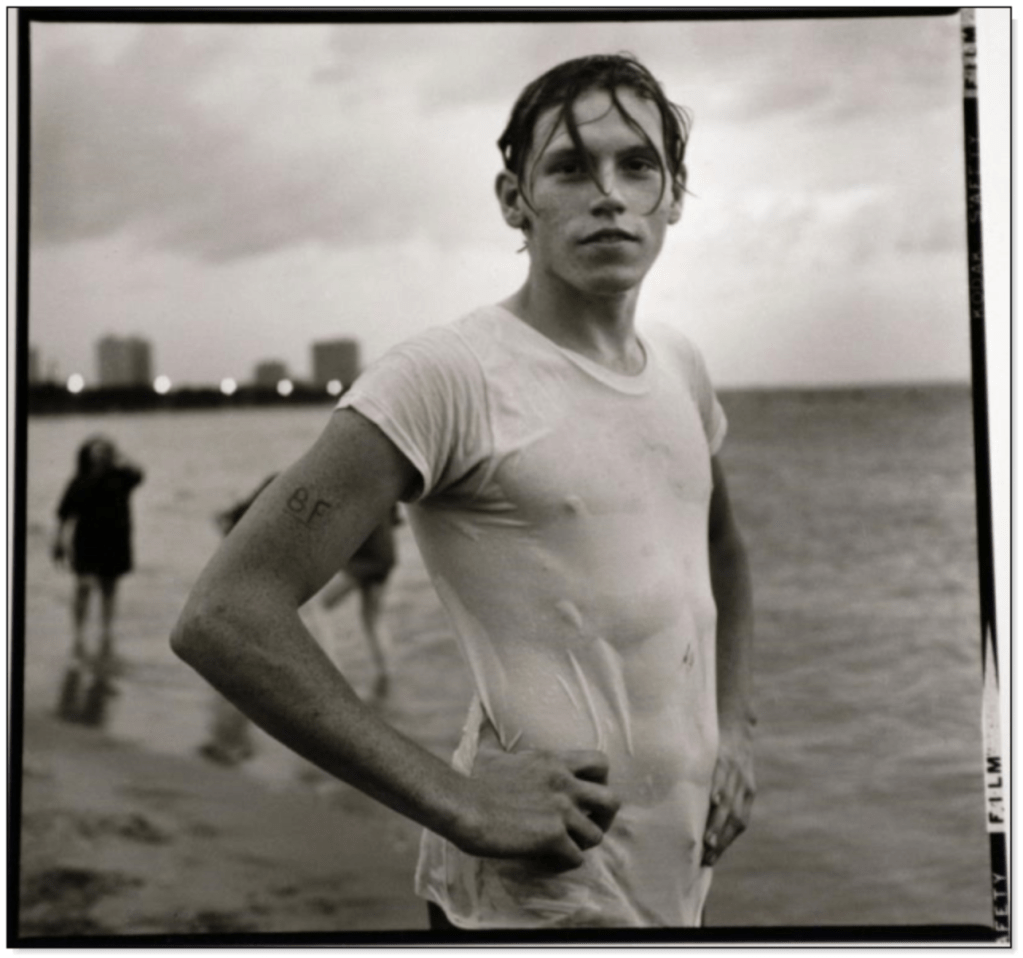
Marc Hauser (1952-2018)
Male Figure on Beach
1973
Photograph; Gelatin Silver
KMA 2014.02.01
Marc Hauser was a portrait photographer with a career spanning over 30 years. Starting at just 13, he photographed both strangers and celebrities. Hauser was known for the way he positioned his models within the frame of the photograph and his use of light when depicting them.
Read about Hauser in his own words in the interview he did with VoyageChicago, January 2018.
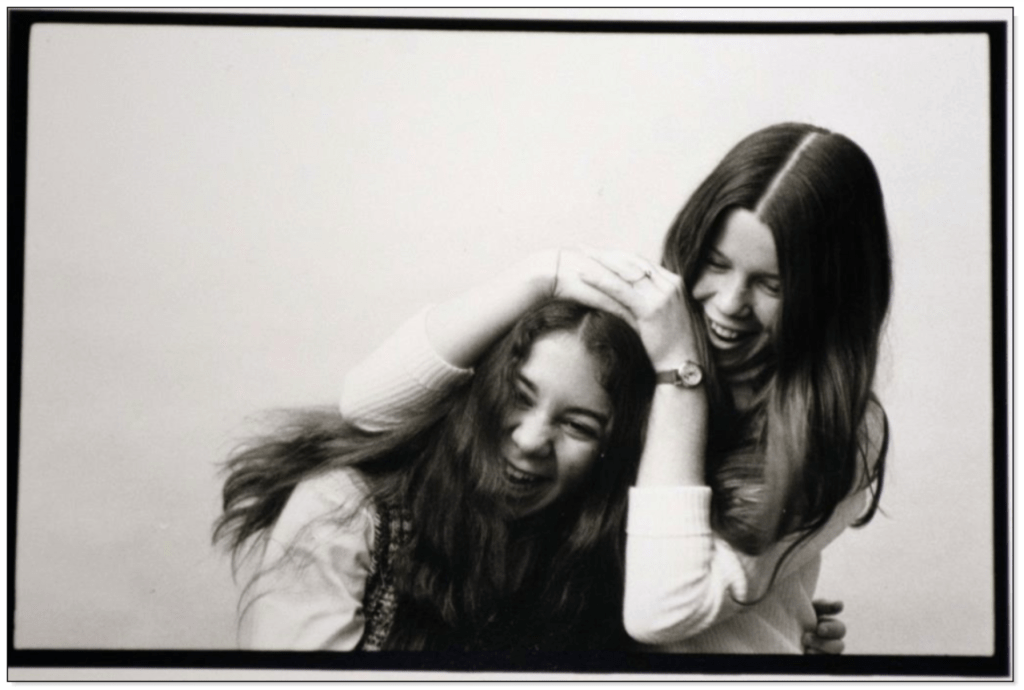
David G. Currie (b. 1941)
Charlie and Carol
1971
Photograph; Gelatin Silver
KMA 2014.03.195
David G. Currie graduated from Ohio University in 1966. His image, Charlie and Carol, stills the priceless, fleeting moment of play and laughter. A professional photographer since 1969, he is quoted as having said, “I am intrigued with the range of possibilities that photography offers, particularly in the areas of teaching and learning about perception, vision, and sensitivity.”
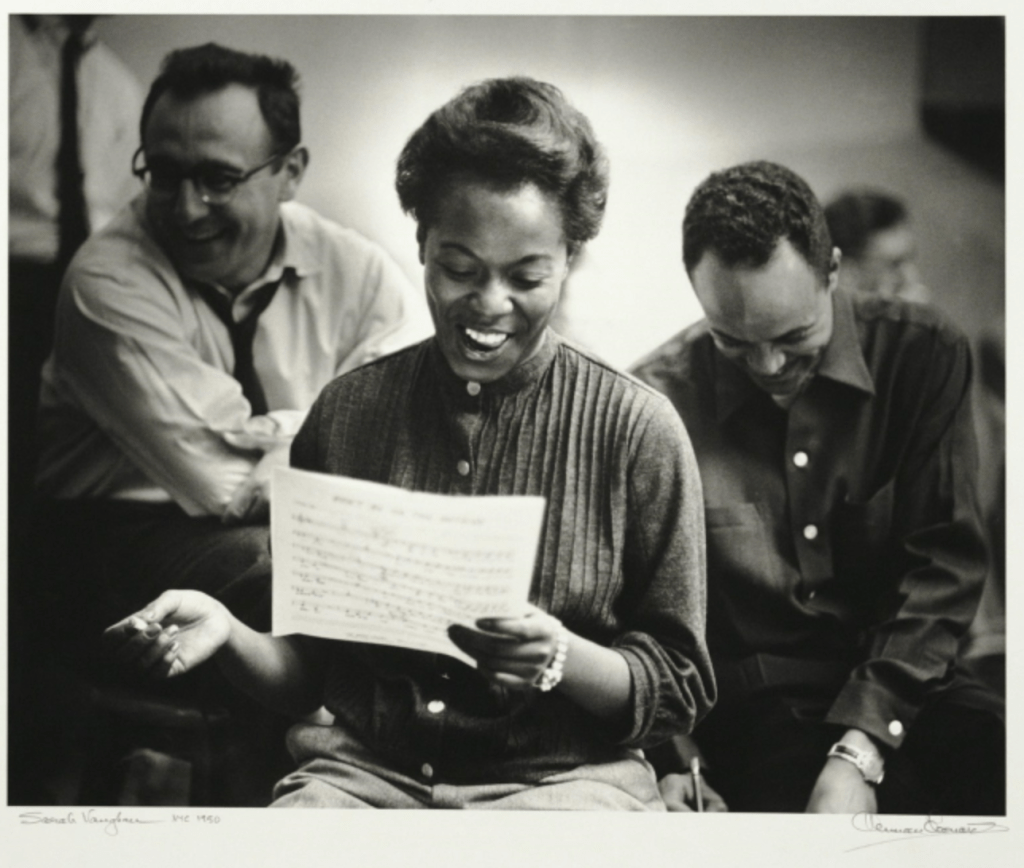
Herman Leonard (1923-2010)
Sarah Vaughn-NYC
1950
Photograph; Gelatin Silver
KMA 93.010.10
Herman Leonard is often heralded as the best jazz photographer of all time. After graduating from Ohio University in 1947, he traveled to Ottawa, Canada, and apprenticed for portrait photographer Yousuf Karsh. Karsh imparted to Leonard, “Tell the truth, but in terms of beauty.” After working with Karsh, Leonard moved to Greenwich Village in 1948. Using photography as a way into the clubs, he intersected with nearly every big name in Jazz—including Sarah Vaughn.
Sarah Vaughn was a Grammy award-winning jazz singer and musician. Leonard’s photo features Vaughn surrounded by colleagues—a relaxed, smiling artist at work.
Follow the links to read more about Herman Leonard, Sarah Vaughn, and to hear Vaughn sing her 1950 version of, “It Might As Well Be Spring,” featuring Miles Davis.
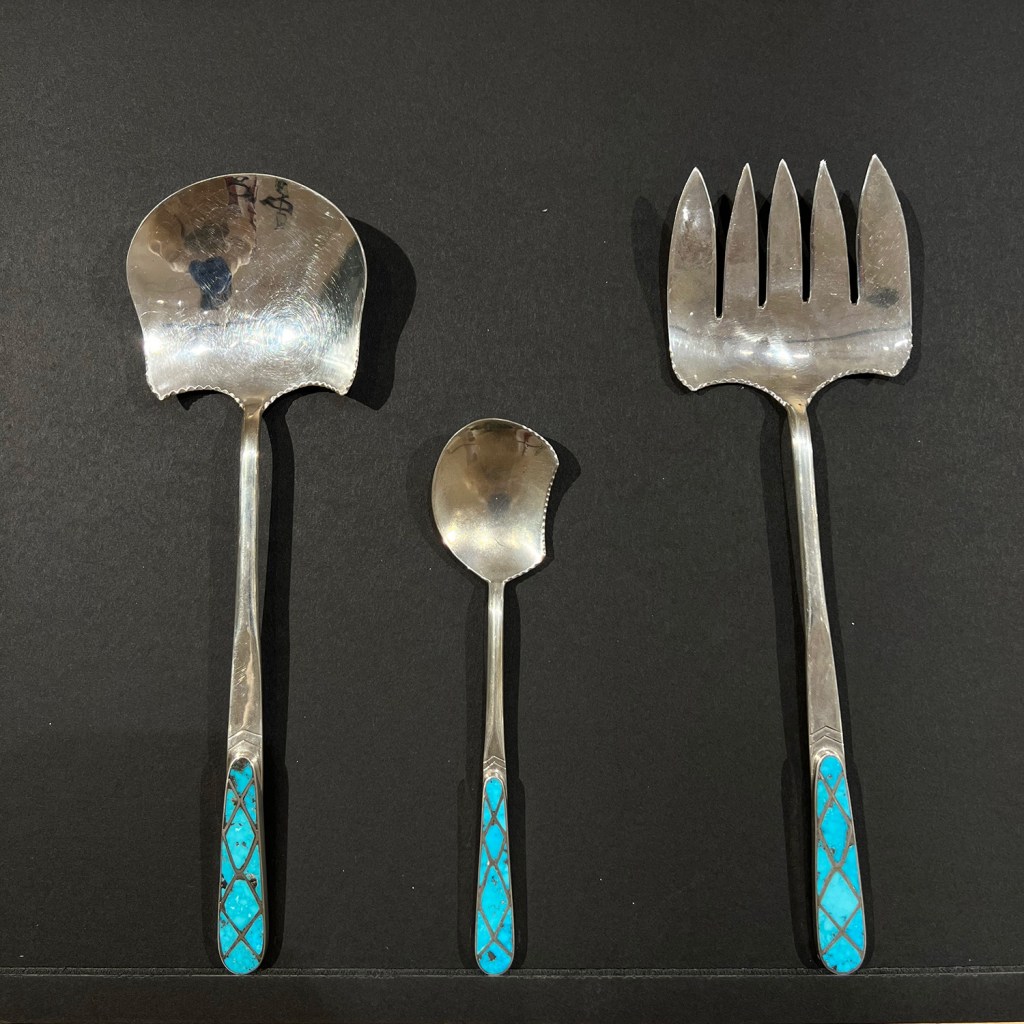
Chee Yazzie (Navajo Silverworker)
Juanita Homer (Zuni Lapidarist)
Channel Inlay Salad Serving Fork and Spoon
Eating and Serving ware; Silver and Turquoise: hand-made silver utensils with channel inlaid turquoise stones (10 stones each)
1962
KMA 89.016.242m (fork)
KMA 89.016.242m.1 (spoon)
The Channel Inlay Salad Serving Fork and Spoon are an artistic collaboration between Silverworker Chee Yazzie (Navajo) and Lapidarist Jaunita Homer (Zuni).
Part of a 110-piece set, these serving utensils are a two-time, award-winning collaboration. The silverwork and channel inlay done by Yazzie and Homer won Best in Show at the Inter-Tribal Arts Show in 1962 and First Prize in Inter-Tribal Ceremonial, Gallup, New Mexico, in 1963.
According to the oral history shared by Navajo Silversmith Ernie Lister, the first Navajo silversmiths repurposed available materials like silver coins to make buttons, belts, and jewelry. Eventually, these silversmiths learned to make their own silver through smelting, an ore purification process involving intense heat. Lister points out that turquoise stones were first introduced to Navajo silversmithing in 1890.
Zuni Lapidarist, Jaunita Homer, set the turquoise stones in the serving ware handles using the channel inlay method. Typically, the artist starts the channel inlay process by pre-forming silver channels. The silver channels create a pattern that is then filled in with meticulously shaped stones, like the turquoise stones on the handles of these serving ware.
The Channel Inlay Salad Serving Fork and Spoon (with additional place settings) are currently on display in the At|On the Table exhibit at the Kennedy Museum of Art.
Follow this link to hear the first-hand account of Navajo Silversmith, Ernie Lister.
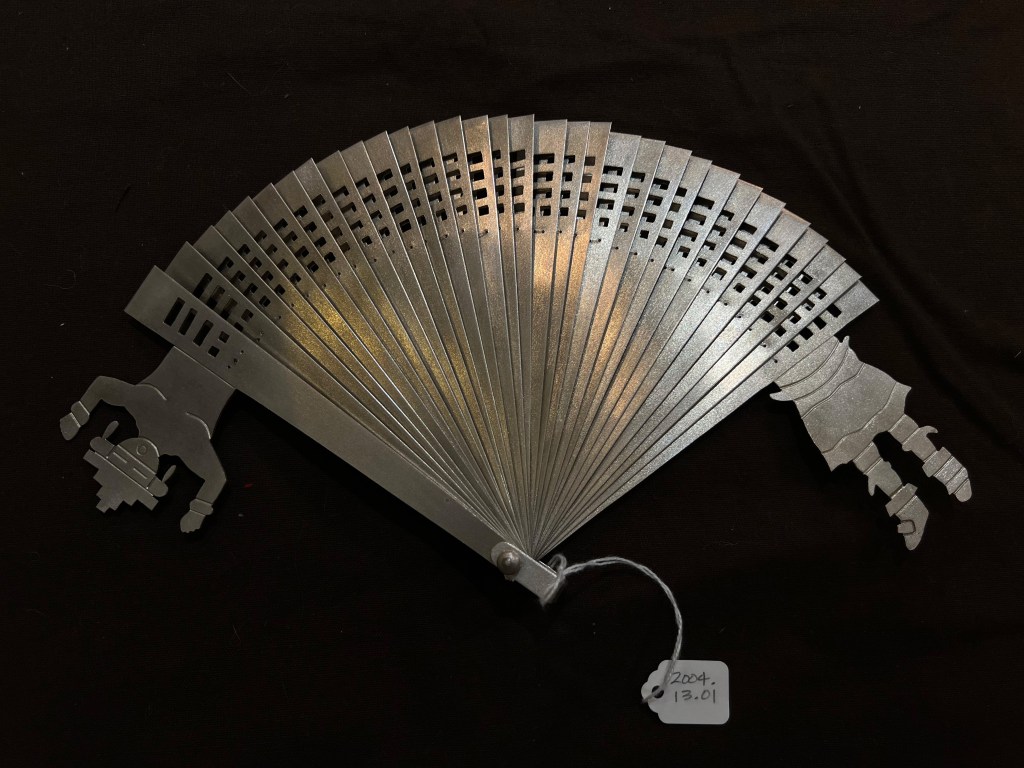
Alex Jamon
Rainbow Man Fan
Cut and assembled silver; 32 blades
2004
KMA 2004.13.01
Alex Jamon was only 15 years old when he created the Rainbow Man Fan. It was made using his familial knowledge in silver working, cultural understanding of sacred figures, and curiosity.
Alex was inspired to make the silver fan after he was gifted a folding fan by a Japanese visitor. Observing similarities between the semi-circular arch of the Japanese fan and the rainbow deity. Alex worked with his father, Zuni silversmith Carlton Jamon, to design and execute the silver fan. Alex and his father worked together to cut and assemble the 32-piece, silver fan that measures 11.5in x 6.5in when open.
As someone coming from both Navajo (his mother) and Zuni (his father) lineage, Alex has a comprehensive understanding of how important the Rainbow Man is to both groups. When seen in sand paintings, weavings, and jewelry, the Rainbow Man is often portrayed as a stretched symbol of protection with his head on one end of the design and legs on the other. Alex designed the fan in the same way.
Platinum (Palladium)
Though they are different elements, platinum and palladium have very similar properties and are often used in similar ways. Extremely non-corrosive, non-reactive, and rare, large platinum deposits have been found in South America and South Africa. Today, platinum is predominantly used in the automotive industry, fine jewelry, and in medical equipment
Platinum (Palladium) Prints
Nearly identical to the gelatin silver process, platinum prints are also created by applying a solution to a surface before it is exposed and developed. The subtle difference is that while the silver salt particles are suspended in gelatin the platinum particles are applied directly onto the surface. This small distinction gives platinum prints distinct warmth and coloring. This can be seen in both of the chosen images.
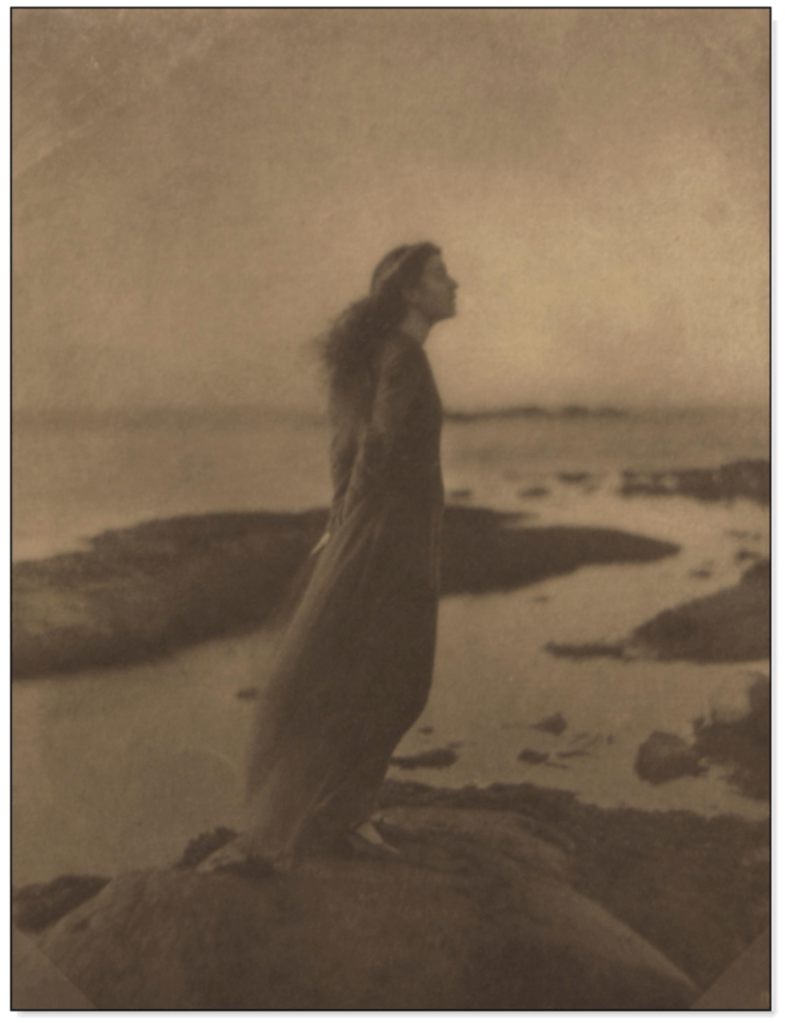
Clarence H. White (1871-1925)
Rose Pastor Stokes,
Caritas Islands, CT
1909
Photograph; Platinum Print
KMA 78.030.14
Clarence H. White was a photographer and educator. As a Pictorialist who was part of the Photo-Secession group of the late 1800’s, he believed that photography was art. He believed that photography could be more than visual reproduction. White’s ability to use the natural elements to his advantage by carefully setting up the lighting, scene, and model are markers of his artistic skill. Knowing that photography was an artform, White committed to a lifetime of learning and practice.
Dedicated to education, White held multiple collegiate positions before establishing his own school of photography in New York City in 1910. He remained dedicated to Pictorialist ideals as well as teaching until his death in 1925. His efforts earned him an induction into the Photography Hall of Fame and Museum, St. Louis, MO, in 1986.
Follow these links to learn more about Pictorialism and Clarence H. White.
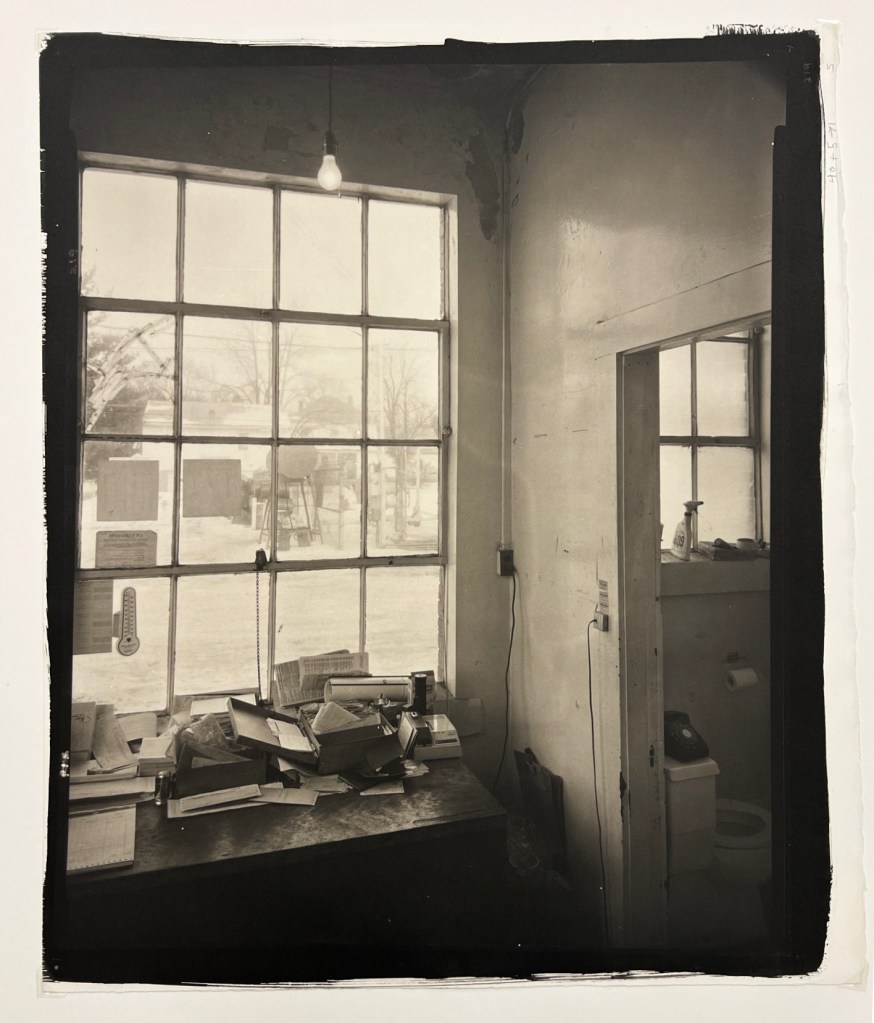
Frank Hunter (b. 1947)
Athens Series (Oil Co. Office)
Photograph; Platinum/Palladium Print
1985
KMA 2014.10.14
Photographer Frank Hunter received his MFA from Ohio University. Predominantly working in landscapes, his work spans the scope of the United States including Iowa, Kentucky, and New Mexico. Looking around the edges of this image, it is possible to see the brushstrokes where Hunter applied the platinum solution onto the paper before taking the photo and exposing it.
This platinum/palladium print comes from Hunter’s Appalachia,collection. Many of the images in this collection pair domestic items like televisions and cars with the natural landscape. They each share the same warm, tonal qualities as well as strongly contrasted lighting.
Click here to see more of Hunter’s Appalachia, collection.
Copper
Gold, silver, and copper are all part of the same elemental group on the periodic table. One of their shared properties is malleability—or how easily it can be manipulated. This is potentially one of the main reasons that copper has been used by humans for over 10,000 years. Copper has been included in the list of precious metals not because it has the most financial value, but because it has been a long-time tool throughout the human timeline.
Copper and Printmaking
Intaglio printmaking and copper go hand-in-hand. Intaglio is a printmaking method where the design is scored into the surface of the matrix—or the material that holds the design. Many intaglio matrices are made from copper. Printmakers ink the surface of the matrix, pressing ink down into the impressions and lines. The print is revealed once the inked matrix is pressed and transferred to paper. There are five intaglio methods: etching, engraving, aquatint, mezzotint, and drypoint. Each process depends on the unique qualities of copper to create the best print.
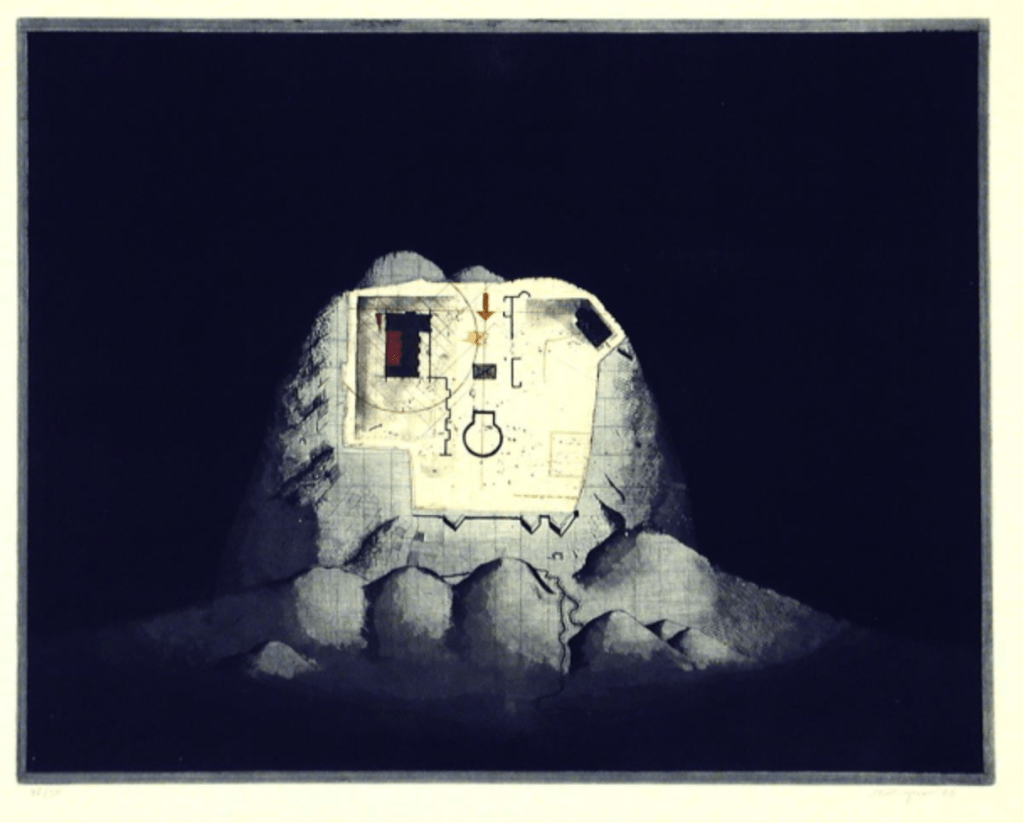
Friedrich Meckseper (b. 1936)
Messingbergwerk (Plate 4 from Seven Wonders)
1966
Intaglio Print
KMA 91.024.21
Originally studying as a mechanical engineer, Meckseper draws inspiration from the technical, mechanical, and detailed elements of his life. Fascinated so much by industrial technology, he traveled extensively in the 1970s-1980s via steamboat and gas balloon.
His prints reflect intense attention to detail and curiosity about how things fit together. Many of his intaglio prints use etching, engraving, and aquatint processes. Meckseper lives and works in Berlin, Germany.
Gabor Peterdi (b. 1915-2001)
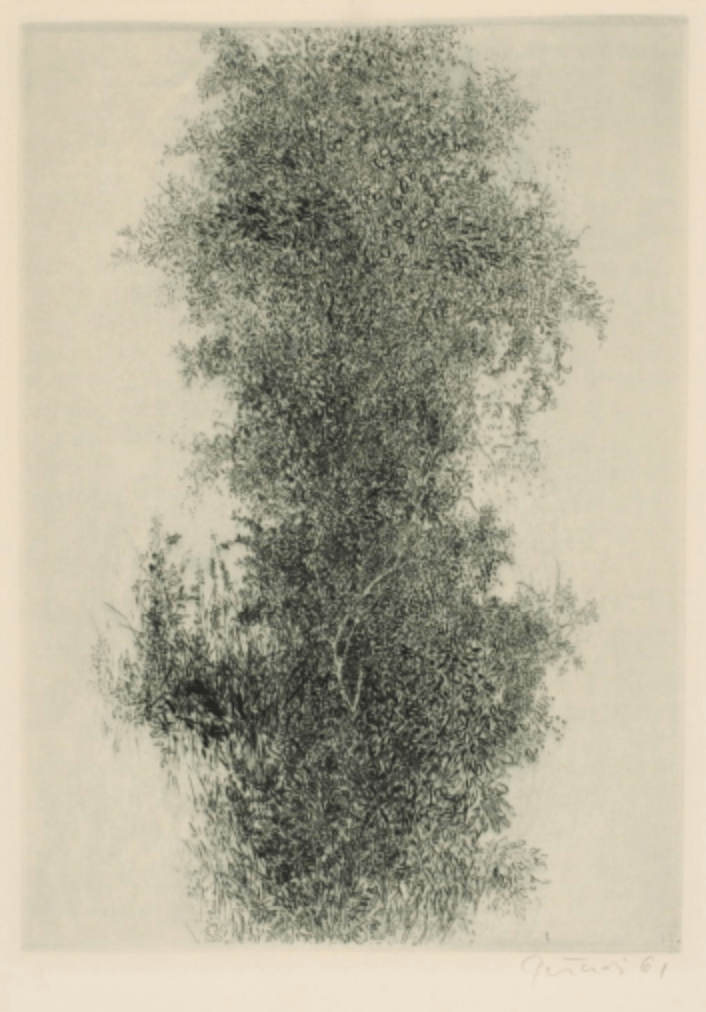
Wisteria
Intaglio Print; Etching, Engraving on Paper
1966
KMA 91.024.21
Peterdi began printmaking at an early age. Winning the Prix de Rome for printmaking at 15, his career progressed from there. A longtime and influential teacher, he was associated with Hunter College, Brooklyn Museum Art School, New York University, and Yale University—where he taught from 1960-1987.
While Peterdi was a painter and printmaker, he is most widely known for his engravings. Interested in both the subject of his work as well as the emotional impact his artwork could have, Peterdi was inspired by the natural world.
Click here to see the Smithsonian’s collection of his work.
Linda Adato (1942-2021)
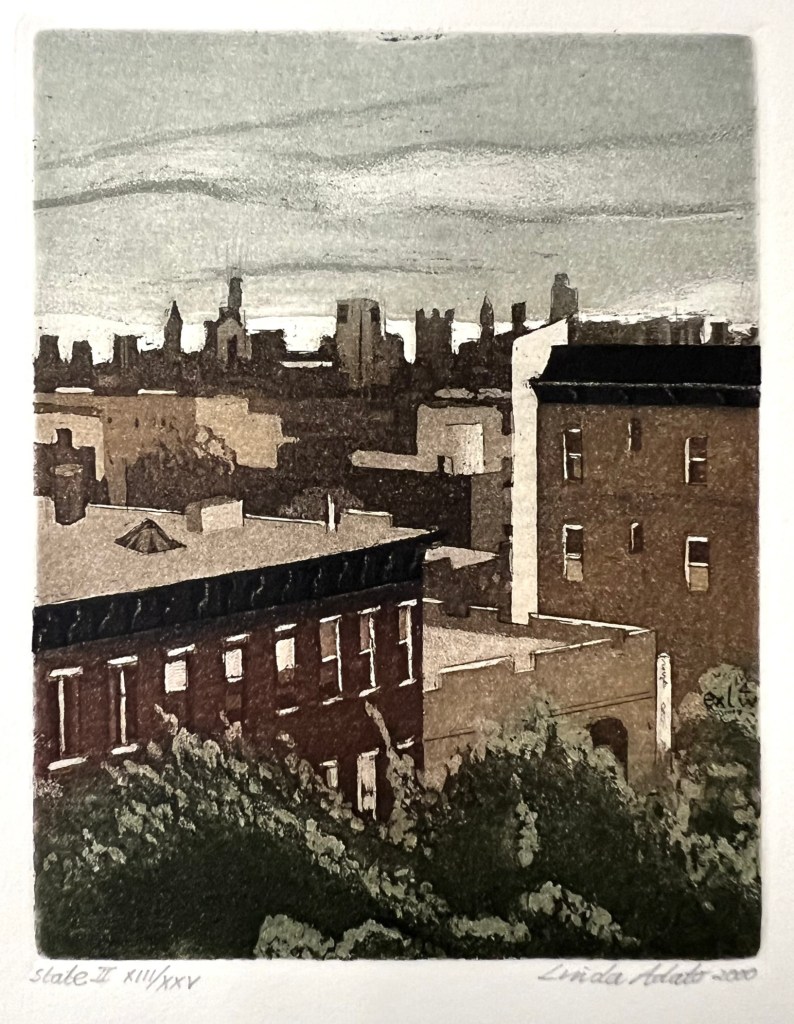
Brooklyn and Beyond
Intaglio; Etching, Aquatint on paper
2000
KMA 2004.16.05
Originally from England, Linda Adato studied at UCLA after immigrating to the United States. Represented by multiple galleries, Adato was also associated with many printmaking groups across the US.
Drawn to the way light and shadow can be pushed in the etching process, Adato often used etching, aquatint, and soft ground to create her prints. She was also a master at ‘a la poupee’, a sometimes difficult printmaking method where the artist uses little daubs of ink in specific areas, simultaneously, to color their print.
Click here for Linda Adato’s website.
Thank you for visiting the KMA Blog, we hope you enjoyed this KMA Picks selection of work. I’m thankful to have had the chance to spend time with the KMA’s Permanent collection of work. A gracious thank you to Sally Delgado, curator of education, for the opportunity to share my selections as well as the KMA Education Team for their assistance and feedback.
Thank you!
Hattie Phillips
Graduate Assistant, Visitor Engagement
 KENNEDY MUSEUM OF ART at Ohio University
You must be logged in to post a comment.