
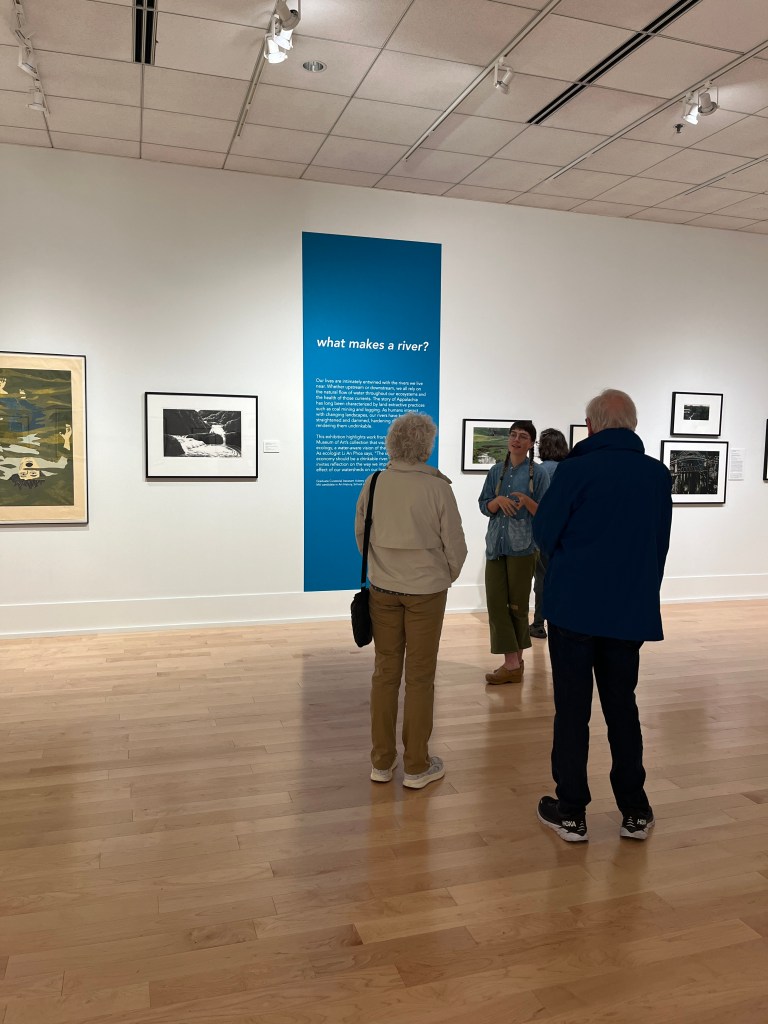
One of the current exhibitions on view at the Kennedy Museum of Art is the exhibition what makes a river?. It is filled with different representations and visualizations of human ecology, with a defining thread of being conscious of the water in the land around us. The exhibition encourages dialogue and reflection on the impact rivers and watersheds have on life. It is also comprised entirely from the permanent collection of the KMA.
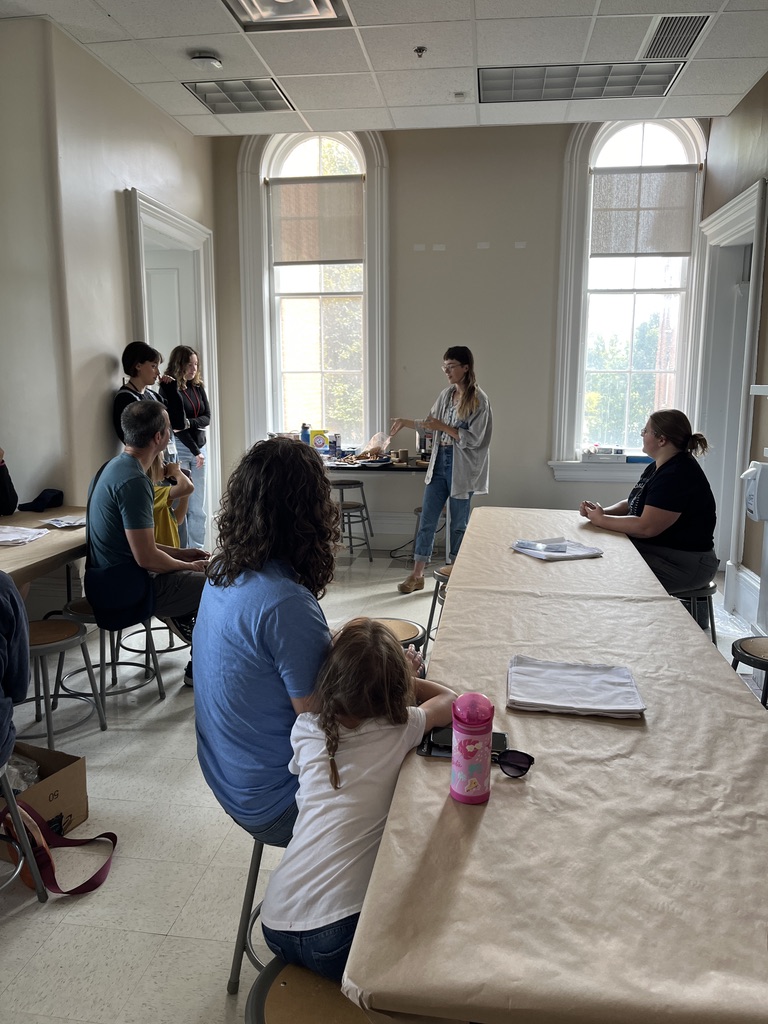
Aubrey jo Blue, pursuing a master’s degree in art history, is the graduate curatorial assistant for this exhibition. Much of Blue’s work is centered around fiber arts, but they also have experience in photography, woodwork, and ceramics. In addition to the what makes a river? exhibition, they have hosted workshops and events at the KMA in tandem with the themes presented in it, which often start with exploring the exhibition first. This has included two previous indigo dye community open studios, two river walks as Front Porch Thursday events, and an upcoming patchwork event, on Oct. 17.
Blue believes that it is important to advocate for community craft access and declares that the concept of it is a “deep part of my essence.”
“The Community Open Studio is a nice way for people to do a one-off workshop where they get the absolute basics,” Blue said. “Perhaps this can be a seed for an interest in natural dye for the future, thinking through the issues of choosing natural dye versus synthetic dyes. We saw a lot of happy faces and really a lot of excitement [about it].”
The previous Community Open Studio opened with a talk about a photograph of black hollyhock flowers, a work within the exhibition, which produce a dark purple dye. The inspiration for the open studio is based in water-conscious natural dye methods. Textile dyeing and production contributes to 20% of water pollution globally. This is another way in which the events are connected to the exhibition—thinking about ways to increase our awareness of our use of water.
Blue is specifically looking forward to the Front Porch Thursday Patchwork Activity, as they said they love the idea of opening up the museum to increase community engagement.
“It’ll be learning to hand sew, basically, which is a skill not a lot of people have or are taught anymore, while also within a creative environment of the museum inspired by the exhibition,” Blue said. “We’ll have indigo dyed scraps from the workshop to work with and [we’ll] learn different methods for mending clothes—which extends the clothing’s life, and prevents clothing waste, which, as we know, textile waste is a major contributor to the pollution of waterways. So, it’s just a small act against the tide of climate change.”
When asked why Blue thought it was important for the community to engage and learn about their watersheds, and particularly the Hocking River itself, Blue expanded on the idea of protecting water on a bigger scale by connecting it with locations people are familiar with.
“Being aware that you, in fact, live and affect land within a watershed is certainly the first step. It’s that awareness that has been taken from us as land-disenfranchised people, and as people who are not originally from this land as well, so [people are] divorced [from] the care of land, which has led to all these issues,” Blue said. They went on further to talk about their origins in Northwest Ohio, by Lake Erie, and the care of water there.
“Where I’m from, we have monoculture corn crop where the runoff goes straight into the river, which goes straight into the lake. This affects the drinking water, which is the most fundamental and tactile thing that people can realize. It’s an essence of what keeps you alive. Because water is life, and without water, there is no life. Basically, what one gains from being in contact with those systems is an understanding of the way that caring for bodies of water, or caring for land, greatly increases all beings’ lives around and in that land, because it’s not just us. It’s everything else that lives.”
Blue went on further to say that currently, people can notice how there is iron oxide running through Sunday Creek in Athens County or see how there are algae blooms in the Hocking River due to the drought. These are observable consequences to the care, or lack of it, of local land and water systems. One quote, by ecologist Li An Phoa, was a springboard for Blue’s idea of the exhibition and encapsulates part of the idea of awareness of water treatment: “The sign of a healthy economy should be a drinkable river.”
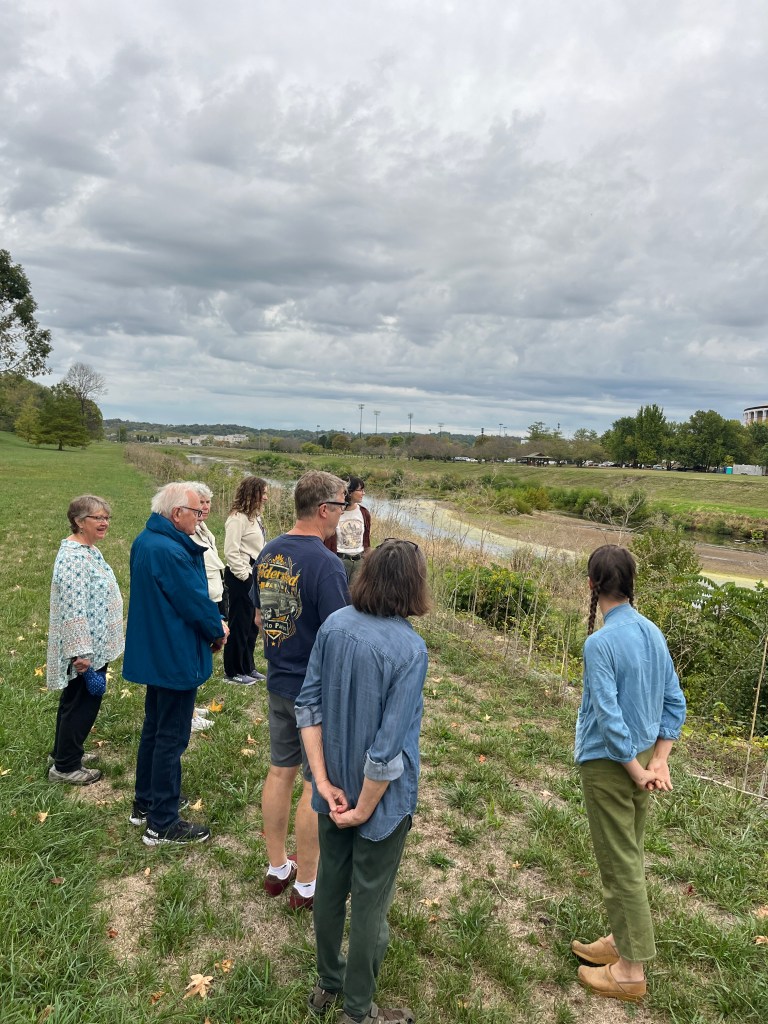
The closeness of the Hocking River allows for the KMA to offer another event with Blue, the river walk, where participants start off in what makes a river? and learn more about the Hocking River and its rechannelization in 1969. This adds another point to the themes of Blue’s exhibition. The river walk is a great way for community members to think about care and preservation, especially in regard to the Hocking River.
“That comes from being responsive to each other, mostly like ‘I’m not going to throw something toxic into the river, because my neighbor downstream is going to be affected by that,’” Blue said, continuing with the concept of empathy toward the environment and toward each other. “And so, if that’s our mindset and the fundamentals of how we’re making decisions that are based on the consequences downstream and upstream, then that is a sign of being a lot more attentive to each other, the bottom line, and what we need as people. That’s where the river idea [for the exhibition] came from. And, with Athens and the history of the Hocking River reroute, all of that was super rich to mine through and make meaning from, especially because we’re so close [to it].”
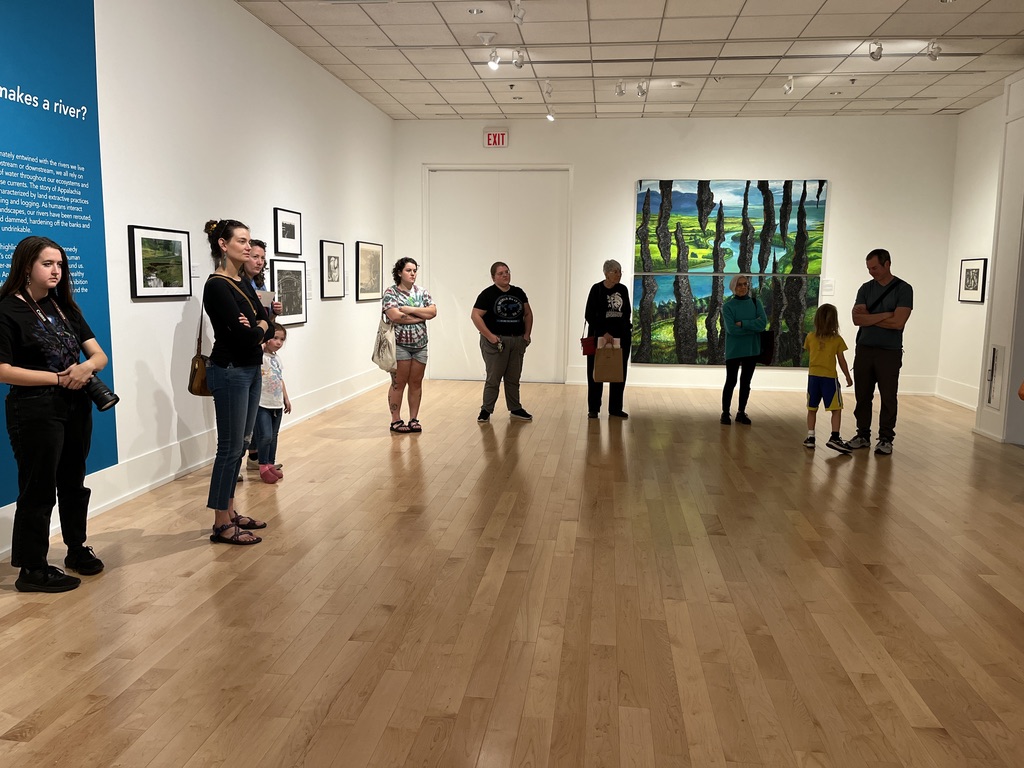
What makes a river? is on view now! It opened on May 31. Check it out while it is still open!
Article written by Maia LeClair, KMA Outreach Programs Assistant (Journalism News and Information major)


You must be logged in to post a comment.